
- admin
- May 17, 2026
- Gorillas and Primates
Gorilla Trekking in Bwindi Impenetrable Forest: Complete 2026 Guide
There is a moment, somewhere in the middle of the forest, when the undergrowth ahead of you moves and you realise — not intellectually, but physically, in your chest — that what is moving through it is not a person.
You have been climbing for two hours. The forest is exactly what the name promises — impenetrable is not a metaphor but a description. The vegetation is so dense and layered that even at midday almost no light reaches the ground. Roots cross and re-cross the path. The air smells of wet earth and rotting wood and something alive and animal underneath everything. Your legs ache. Your shirt is soaked through. Your tracker is somewhere ahead, moving through this with a machete and a radio, following signs you cannot read.
And then the guide ahead of you stops. Raises a fist. Points into the wall of green.
You look. You see nothing.
Then the green shifts, and a face looks back at you. Dark eyes. A broad flat nose. An expression of complete, unhurried composure — the composure of an animal that has no predators and knows it. A silverback mountain gorilla, sitting in the undergrowth fifteen metres away, watching you with the calm of something that has been here far longer than you and expects to be here long after you have gone.
Nothing fully prepares you for this moment. That is not a marketing claim — it is the unanimous testimony of almost everyone who has ever experienced it.
This guide will get you there.
Why Uganda, and Why Bwindi
Mountain gorillas (Gorilla beringei beringei) exist in exactly one place on Earth: a cluster of forests straddling the borders of Uganda, Rwanda, and the Democratic Republic of Congo, centred on the Virunga Massif and the Bwindi Impenetrable National Park.
There are approximately 1,063 mountain gorillas left in the world. This is not a large number. It is, however, a number that is growing — one of the rare conservation success stories of the past three decades, driven directly by the economic value that gorilla tourism creates for local communities and governments. Every permit purchased for a gorilla trek is, in a direct and unambiguous way, conservation funding.
Of the mountain gorilla population, roughly half live in Bwindi. The other half are split between Mgahinga Gorilla National Park (Uganda’s smallest park, sharing the Virunga ecosystem with Rwanda and DRC) and the Virunga ranges of Rwanda’s Volcanoes National Park and DRC’s Virunga National Park.
Why choose Uganda over Rwanda?
Rwanda’s Volcanoes National Park — the other major gorilla destination — is closer to Kigali, more accessible, and comes with exceptional high-end accommodation. It is also significantly more expensive: Rwanda’s gorilla permit costs $1,500 per person. Uganda’s permit costs $700 per person — still a meaningful sum, but considerably less for an equivalent experience.
Bwindi itself is the more diverse and ecologically complex forest. It is one of Africa’s oldest rainforests, having survived the last Ice Age as a refugium — an island of persistent vegetation — and consequently harbours a biodiversity that astonishes biologists: over 120 mammal species, more than 350 bird species (including 23 Albertine Rift endemics), and over 1,000 plant species in an area of roughly 330 square kilometres. The gorillas are the headline act in an extraordinary supporting cast.
The terrain is harder than Rwanda. The word “impenetrable” will earn its meaning somewhere on every trek. But for most people who have done both, Bwindi feels more genuinely wild — less manicured, more demanding, more rewarding.
The Gorilla Families: Who You Might Meet
Bwindi is divided into four trekking sectors, each managed independently, each with its own habituated gorilla families.
Buhoma — the original and most established sector, in the north of the park. Home to several well-habituated families including the Mubare group, the first to be habituated for tourism in 1993. Buhoma has the most developed tourist infrastructure and the widest range of accommodation, from budget to luxury. The most accessible sector from Kampala, typically reached in six to seven hours by road or forty-five minutes by charter flight.
Ruhija — in the northeast, the highest of the four sectors and the coldest. Home to the Bitukura and Oruzogo families, among others. The altitude makes trekking here particularly demanding, but the forest is spectacular and visitor numbers are lower than Buhoma. The Bitukura family is notably relaxed around humans — the interactions here are often described by guides as among the most intimate in the park.
Rushaga — in the south, the largest sector in terms of habituated families. The Nkuringo, Mishaya, Busingye, and Bweza groups, among others, are all based here. Rushaga has expanded significantly in recent years and is increasingly popular for its diversity of family options and its relatively accessible terrain on the park’s southern fringes. Good proximity to Lake Mutanda and the Virunga border.
Nkuringo — also in the south, named for the ridge on which the main camp sits. Home to the Nkuringo family — a large and well-established group whose territory spans dramatic terrain with views across to the Congo. The trekking here can be among the most physically demanding in the park but the scenery is exceptional.
Each sector has different families at different stages of habituation, with different group sizes and dynamics. Your operator will advise on which sector suits your fitness level and particular interests.
The Permit: Everything You Need to Know
A Uganda gorilla trekking permit currently costs USD $800 per person for foreign non-residents, $700 for foreign residents of Uganda or East Africa, and UGX 250,000 for East African citizens.
The permit covers one hour in the presence of the gorilla family — timed from the moment of first contact, not from when you leave camp. It is non-transferable and non-refundable. It is also the single most important booking in your entire Uganda itinerary, and it needs to be secured early.
How to get one:
Permits are issued by the Uganda Wildlife Authority (UWA) and can be booked directly through the UWA website or — far more reliably — through a licensed Ugandan tour operator. Booking through an operator is strongly recommended: they handle the logistics of matching your permit to your accommodation and transport, can advise on sector selection, and have direct relationships with UWA that make resolving problems significantly easier.
How far in advance:
Peak season permits (June–September and December–February) should be booked three to six months in advance, and in some cases up to a year ahead. Outside peak season, one to three months is usually sufficient, though last-minute permits occasionally become available through cancellations. Do not build an itinerary around the assumption of a last-minute permit.
Each permit allows one trek to one gorilla family. If you want a second trek — a different family, a different sector, a different day — you need a second permit. Many visitors do two treks, especially those who have come a long way.
What the permit does not cover: Accommodation, transport, park entry fees, ranger and porter tips, or any other costs associated with the trip.
The Trek Itself: What Actually Happens
The night before: You check in to your lodge, attend a briefing by park rangers, and receive your gorilla family assignment. You are told approximately how far the previous day’s trekking group had to walk to find that family, which gives you a rough sense of what tomorrow holds. Distances are genuinely unpredictable — gorillas move, sometimes significantly, between one day and the next.
The morning: Breakfast at your lodge, then a transfer to the park gate by 7:30–8am. Rangers give a final briefing: no flash photography, stay seven metres from the gorillas at all times (a rule the gorillas themselves do not always observe), no eating or drinking within sight of the family, no trekking if you have symptoms of a communicable illness. Mountain gorillas share approximately 98% of human DNA and are highly susceptible to human diseases — a common cold can be fatal to an infant gorilla.
The porter question: At the gate, local community members offer their services as porters, carrying your bag and providing physical support — a helping hand up steep slopes, a steadying presence on the descent. Porters are paid a standard fee (currently around $15–20 for the day) plus tip. Hiring one is not mandatory. It is, however, strongly recommended for anyone who is not in excellent physical condition, and a good idea for almost everyone else. The money goes directly to local families, many of whom lost farming land when the park was gazetted. It is one of the most direct community benefit transactions in African conservation tourism.
The trek: Your group sets off with two armed rangers and a tracker. Group size is limited to eight people maximum per gorilla family per day — one of the most important conservation regulations in the park, and the primary reason the experience feels intimate rather than touristic.
The length and difficulty of the trek is the single most variable element of the entire experience. On a good day, you might find the gorillas within forty-five minutes of the gate, moving through relatively open forest on flat-ish ground. On a difficult day, you might climb for four hours through near-vertical terrain, pushing through vegetation so dense that your ranger cuts a path with a machete in real time. Most treks fall somewhere between these extremes — two to three hours of hiking, with mixed terrain, leading to a location somewhere in the park’s interior that you could not find again on your own.
The difficulty is genuinely real and should be taken seriously. Bwindi’s terrain is steep, the ground is frequently muddy, roots and undergrowth create constant tripping hazards, and the altitude in some sectors (up to 2,500 metres) adds a cardiovascular element. People with knee problems, hip replacements, serious heart or lung conditions, or mobility limitations should consult both their doctor and their operator before booking. The park does offer sedan chair porterage for those who cannot walk the terrain — a service provided by community members and available for an additional fee — but this needs to be arranged in advance.
The hour: When the tracker signals contact, the group assembles as quietly as possible and begins to move toward the family. The ranger instructs you — whispered, hand signals — on positioning. You stay together, move slowly, keep your distance.
And then you see them.
What follows is one hour of something that is genuinely difficult to categorise. It is not like watching animals at a zoo or through binoculars on a game drive. The gorillas acknowledge your presence — they know you are there — and largely disregard it. They go about their lives. The silverback eats. An infant plays on its mother’s back. Two juveniles wrestle in a tangle of limbs. A young male sits on a branch above you and examines your group with an expression that contains, unmistakably, something like curiosity.
The seven-metre rule gets tested. Gorillas move through the undergrowth without particular regard for human spatial preferences, and it is not uncommon for a family member to walk closer to the group than regulations technically permit. Rangers manage this calmly and without drama — a gentle noise, a slow repositioning of the human group. It is considered bad form to run or show alarm, and the gorillas, for their part, give no indication that they consider you a threat worth addressing.
The hour ends faster than any hour you have ever experienced. You walk back out — usually faster than you walked in, once the adrenaline recedes and the fatigue sets in. At the gate, your group is presented with certificates. You sit down. Someone brings tea.
And then you try to explain what you just saw, and find, for probably the first time in your life, that your vocabulary is genuinely inadequate.
When to Go
Uganda sits on the equator, which means it has two wet seasons and two dry seasons rather than the temperate world’s single annual cycle.
June–September (long dry season): The best time to trek. Trails are drier, vegetation is slightly less dense, and the forest is at its most navigable. This is peak season and the period when permits are hardest to secure. Accommodation rates are at their highest.
December–February (short dry season): The second-best window. Less busy than the June–September peak, and permits are somewhat more available. Bwindi’s Christmas season is increasingly popular with visitors combining gorilla trekking with a wider Uganda itinerary.
March–May (long rains): Trails are muddy, vegetation is dense, and the trekking is at its most physically challenging. Permits are available. Some operators offer significant discounts. For travellers who are physically fit and budget-conscious, this period offers the same experience for considerably less money — with the bonus that the forest, in full green season, is extraordinarily beautiful.
October–November (short rains): Similar to the long rains, with variable conditions and lower visitor numbers.
The honest truth: gorilla trekking is worthwhile in any season. The gorillas do not migrate. The families are habituated year-round. The hour in their presence does not change based on weather. What changes is how hard it is to get there.
Getting to Bwindi
Bwindi is in southwestern Uganda, near the borders of Rwanda and the Democratic Republic of Congo. From Kampala, it is a long journey however you approach it.
By road: Eight to ten hours from Kampala, depending on which sector you are heading to. The road through Kabale and onward to Buhoma or Rushaga is largely tarmac to Kabale, then unpaved. The drive through southwestern Uganda — past Lake Mburo, through the tea plantations of Kabale, descending into the Bwindi valley — is genuinely beautiful and many operators include a night in Kabale or at Lake Bunyonyi to break the journey.
By charter flight: Uganda’s domestic aviation network serves Bwindi via airstrips at Kihihi (for Buhoma and Ruhija) and Kisoro (for Rushaga and Nkuringo). Charter flights from Entebbe or Kampala take approximately one hour and are the preferred option for those combining Bwindi with other parks (Queen Elizabeth, Murchison Falls) and wanting to minimise road travel. Aerolink Uganda and Eagle Air operate these routes. Expect to pay $300–$600 per person per flight sector.
Where to Stay
Accommodation around Bwindi ranges from budget bandas to some of the finest lodge experiences in East Africa.
Luxury:
Bwindi Lodge (Buhoma) — perched on the forest’s edge with views across the Bwindi valley, this is the benchmark luxury option in the north. Eight cottages, exceptional food, a team deeply knowledgeable about the park and its gorilla families.
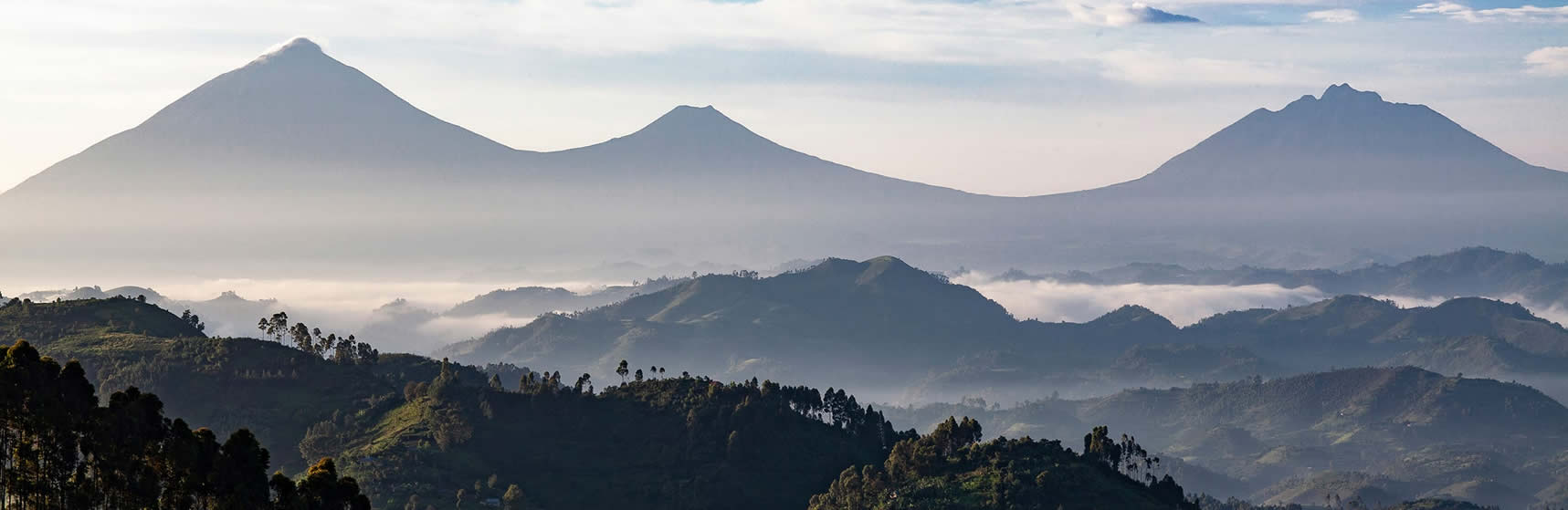
Clouds Mountain Gorilla Lodge (Nkuringo) — arguably the most dramatically positioned lodge in Uganda, sitting on a ridge above Bwindi with views to the Virunga volcanoes. The finishes are exceptional and the atmosphere is genuinely special. Long been a benchmark for southern Bwindi.
Sanctuary Gorilla Forest Camp (Buhoma) — eight tents positioned inside the national park boundary itself, meaning gorilla families sometimes pass within metres of the camp. One of the most immersive experiences in Africa.
Mid-range:
Buhoma Lodge — well-managed, comfortable, good food, strong conservation credentials. Owned and run by a community trust that channels profits into local development projects. One of the better value options in the north.
Rushaga Gorilla Camp — solid option for the southern sector, with comfortable bandas, reliable service, and good community connections.
Budget:
Buhoma Community Rest Camp — basic, community-run, clean. Shares profits with local families. The right choice for budget-conscious travellers who want their money to stay in the community.
Trekkers Hostel (Buhoma) — dormitory and private room options. Functional and fine for those whose priority is the trek rather than the accommodation.
The Gorilla Habituation Experience
Beyond the standard gorilla trek, Uganda offers a second, rarer gorilla experience: the Gorilla Habituation Experience (GHEX).
Where a standard trek allows one hour with a fully habituated gorilla family, the habituation experience gives you four hours with a family that is still in the process of being accustomed to human presence. You join the researchers and rangers who visit the family daily, gradually reducing the animals’ wariness of humans until — over a period of two to three years — the family is calm enough for standard tourism.
The experience is rawer and less predictable than a standard trek. The gorillas may move frequently, trying to avoid the human group. The terrain can be more challenging because you follow the family rather than waiting in position. But the extended contact — four hours rather than one — gives a depth of observation that is simply not available on a standard permit.
The habituation permit costs $1,500 per person and is currently available in the Rushaga sector. Groups are limited to four people maximum. It is significantly more expensive but, for serious wildlife enthusiasts or those making a once-in-a-lifetime trip, arguably the most extraordinary wildlife experience available anywhere in Africa.
What to Pack
Clothing:
- Long-sleeved shirts and long trousers in neutral or dark colours (light colours show every mud mark immediately and drying takes the whole next day)
- Waterproof jacket — not optional in a rainforest
- Sturdy waterproof hiking boots with ankle support — this is the single most important equipment decision you will make
- Garden gloves or lightweight work gloves for grabbing roots and branches on steep sections
- Gaiters are useful for keeping mud and insects out of boot tops
Kit:
- A small daypack, no larger than 20–25 litres — you are moving through dense forest and a large pack becomes a liability
- Rain cover for the pack
- Two litres of water minimum
- High-energy snacks — the trek is physically demanding and you will not eat until you return
- Insect repellent with DEET — the forest has tsetse flies, though the malaria risk in Bwindi’s altitude is lower than lower-elevation Ugandan parks
- Walking stick or trekking pole — many guides provide these at the gate from local wood, but bringing your own collapsible poles is better
Camera:
- No flash photography is permitted under any circumstances
- A camera with fast autofocus performs better than a phone in low forest light, where images can blur as gorillas move
- A zoom lens is useful for wide shots but many of the most memorable images are taken at very short distances — you do not always need reach
- Waterproof bag or cover for your camera
Beyond the Gorillas: What Else Bwindi Offers
The gorillas are the reason almost everyone comes. The forest would justify a visit even if they were not here.
Chimpanzee trekking: Queen Elizabeth National Park, a few hours from Bwindi, has habituated chimpanzee groups in the Kyambura Gorge — a dramatically scenic forest-filled ravine. Combining Bwindi with Queen Elizabeth and Kyambura is one of the finest great ape experiences available anywhere, and it is uniquely Ugandan.
Birding: Bwindi is one of Africa’s premier birding destinations. The African green broadbill, the Shelley’s crimsonwing, the short-tailed warbler, the handsome francolin — species found here and nowhere else or almost nowhere else. A dedicated birding morning in the forest before or after a trek is worth arranging.
Community walks: Several community tourism programmes operate around Bwindi’s borders — walks through villages, visits to Batwa Pygmy communities (the original forest inhabitants displaced when the park was gazetted in 1991, whose relationship with conservation tourism is complex and worth understanding), craft markets, traditional dance performances. These are not optional extras — they are a significant part of understanding what gorilla conservation actually costs at the community level, and where that permit money is going.
Lake Bunyonyi: Uganda’s deepest lake, an hour from Bwindi, ringed by terraced hillsides that look like something from Southeast Asia. An excellent place to rest before or after a trek, with kayaking, swimming, and some of Uganda’s nicest small guesthouses perched above the water.
The Ethics of Gorilla Tourism
Gorilla trekking exists in an ethical space that is worth examining rather than taking on faith.
The conservation case for gorilla tourism is strong and well-documented. Mountain gorilla numbers have increased from around 620 in the 1980s to over 1,000 today, during a period when gorilla tourism has been the primary funding mechanism for anti-poaching, ranger salaries, veterinary interventions, and community benefit schemes that give local people an economic reason to support conservation rather than oppose it. The species’ recovery is directly linked to the value created by the $700 permit.
The Batwa question is more complicated. The Batwa Pygmies lived inside what is now Bwindi Impenetrable National Park for thousands of years and were evicted — without meaningful consultation or adequate compensation — when the park was gazetted in 1991. Many Batwa communities remain among Uganda’s poorest people. Some community tourism programmes attempt to address this; most do not do so adequately. Visitors who engage with Batwa cultural tourism should do so critically, ensuring that money goes to Batwa communities directly and not primarily to intermediaries.
The seven-metre rule exists for the gorillas’ protection, not yours. The habituation of gorilla families to human presence is itself an intervention — it makes the gorillas calmer around people but also, potentially, less wary of poachers. The ranger presence on every trek is partly anti-poaching. Your permit payment funds those rangers.
None of this means you should not go. It means you should go with your eyes open, choose operators who are transparent about where money flows, engage with community programmes honestly, and understand that the hour you spend in the forest is embedded in a conservation and political economy that extends well beyond that experience.
Planning Your Itinerary
A minimum viable Bwindi itinerary is three nights — enough for one trek, with travel days on either side. Most visitors find that three nights feels rushed and that four to five nights, allowing a second trek or time to explore the area, is significantly better.
A seven-night Uganda itinerary combining Bwindi with Queen Elizabeth National Park:
- Day 1: Fly into Entebbe, overnight Kampala or Entebbe
- Day 2: Charter flight to Kihihi or drive through western Uganda, overnight Buhoma
- Day 3: Gorilla trek, afternoon rest or community walk
- Day 4: Gorilla habituation experience or birding morning, transfer or flight to Queen Elizabeth NP
- Day 5: Game drive, Kazinga Channel boat cruise
- Day 6: Chimpanzee trekking, Kyambura Gorge
- Day 7: Morning game drive, transfer to Entebbe for evening flight
This covers mountain gorillas, chimpanzees, savanna wildlife (lion, elephant, buffalo, Uganda kob, hippo, crocodile), and one of Africa’s finest water-based wildlife experiences — all in a week, all in Uganda.
One Last Thing
The gorilla does not perform for you. It does not know it is the reason you flew eight thousand kilometres, bought a $700 permit, climbed through a rainforest for three hours, and spent the previous week telling everyone you know where you were going.
It is simply living — eating, resting, playing, grooming — in a forest it has inhabited far longer than human beings have been keeping records of anything. And you are permitted, for one hour, to watch.
That permission is given by the Uganda Wildlife Authority, funded by your permit, protected by the rangers, and earned — in a sense that becomes clear only in the presence of the animal itself — by the gorilla’s own extraordinary tolerance of the strange, upright, camera-carrying creatures who come to find it in the forest every morning.
Use the hour well. Leave no trace. And if the silverback looks directly at you — hold the eye contact, stay calm, and understand that you are looking at the closest living relative of your entire species in a forest that has existed since before the first human being stood upright.
There is nothing else on Earth quite like it.
Permit bookings: Uganda Wildlife Authority — www.ugandawildlife.org. Recommended operators: Volcanoes Safaris, Wild Frontiers Uganda, Acacia Adventures Uganda, Nkuringo Walking Safaris. All hold UWA licences and have established community relationships in the Bwindi region.