Self-Drive Safari in East Africa — 4×4 Car Hire from Kigali
Experience the marvels of East Africa the way you want to. Self-drive car hire in East Africa offers you convenience and freedom, available from Kigali in Rwanda all the way through Uganda, Kenya and Tanzania. Whichever way you decide to go – whether for an East African tour or for overland safaris in several countries, our range of well-maintained 4x4s will get you there.
Travellers in search of independence will find our one-way car rental in East Africa to be their best bet – rent the car from one point and return it to another, leaving behind the tedious process of backtracking. Whether it’s for an individual, couples or even family car hire in East Africa, we can give you great car rental rates that won’t burn a hole in your pocket.
Why Choose a Self-Drive Safari in East Africa?
East Africa is one of the most naturally diverse regions on the entire continent, making it one of the top destinations for independent self-drive safari holidays. Its lush tropical landscapes sustain an extraordinary range of wildlife and cultures found nowhere else in Africa.
In Uganda and Rwanda, ancient rainforests shelter some of the world’s most endangered primates. Bwindi Impenetrable Forest in Uganda and Volcanoes National Park in Rwanda are globally celebrated for gorilla trekking self-drive itineraries, offering rare, up-close encounters with mountain gorillas. Kenya’s Masai Mara and Tanzania’s Serengeti are iconic stages for the Great Wildebeest Migration — a spectacle best witnessed at your own leisure when you hire a 4×4 vehicle for a Kenya–Tanzania safari.
One of the most common facilities provided by our organisation includes the facility of one-way car rental for overland journeys in East Africa across various countries. Rather than retracing your steps on the same road, you can plan a continuous route for your overland journey, such as starting off in Kigali, passing through the national parks of Uganda, visiting the Masai Mara in Kenya, and then finally ending up in Arusha, Tanzania.
One-way car rental for overland tours in East Africa is perfect for those travellers who have only limited time at their disposal but want to cover the longest distance possible. All the vehicles offered by us come fully loaded for any overland journey.
Whether you are planning a 7-day Uganda self-drive safari, a 10-day Kenya and Tanzania road trip, or a two-week multi-country East Africa overland tour, our car hire and one-way rental solutions are designed to make your independent adventure as seamless and rewarding as possible.
Self-drive travel is increasingly the preferred choice among independent travellers across East Africa because it offers unmatched privacy, the freedom to adjust your itinerary daily, and the ability to linger at locations that matter most to you. For those with a love of mountains, the Rwenzori Mountains in Uganda and Mount Kilimanjaro in Tanzania are also accessible for guided hikes when combined with a long-term 4×4 car hire in East Africa.
Drive through Kenya Self-drive safari
Planning a self-drive safari in Kenya without a tour operator? Here is everything you need to know about the best routes, national parks, and wildlife experiences for an unforgettable independent road trip through Kenya
Explore Uganda, the pearl of Africa
Planning a self-drive safari in Uganda? Discover the Pearl of Africa's most iconic destinations — from Bwindi's mountain gorillas to Queen Elizabeth's tree-climbing lions. Your ultimate Uganda self-drive safari guide starts here
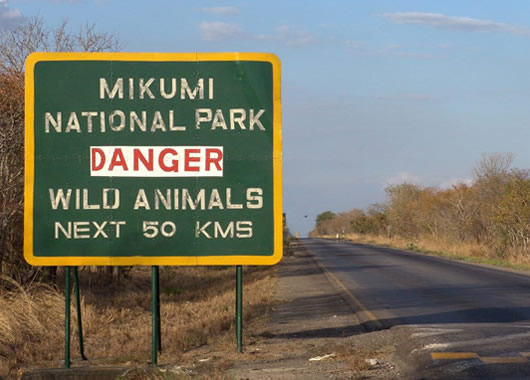
Adventure through Tanzania
Tanzania is one of the last places on Earth where you can watch a million wildebeest thunder across open plains, encounter lions lazing in ancient craters, and feel the pulse of raw, untouched Africa
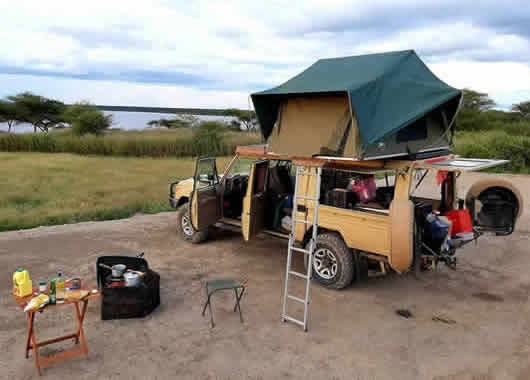
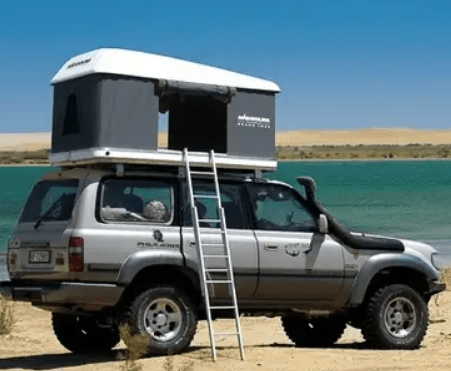
For a real and unforgettable bush adventure in East Africa, nothing beats a self-drive camping safari tour complete with a rooftop tent. Camping provides an opportunity to explore your surroundings on the move, all at a very affordable price and with unmatched convenience. The vehicles used in our East African self-drive camping safaris are specially modified 4×4 jeeps fitted with rooftop tents designed specifically for camping in the bush. They are ideal for camping in national parks and game reserves, offering safety by elevating the tents and putting you right in the middle of the action. Well-kept and well-equipped camping grounds in Uganda, Kenya, Rwanda, and Tanzania offer designated camping sites at a low fee. The public camping sites within national parks cost about $20 per person per night without including the park entrance fee.
East Africa Self-Drive from Rwanda — A Complete Guide
This is one of the most rewarding overland adventures on the continent — four countries, mountain gorillas, the Great Migration, volcanic craters, and endless savannah, all under your own steam. Here’s everything you need to know.
The Route Overview
Rwanda → Uganda → Kenya → Tanzania — roughly 18–21 days covering around 3,000 km of driving. The route loops through the highland forests of the western Rift Valley before opening up into the great plains of the east.
🇷🇼 LEG 1: Rwanda — Volcanoes National Park (Days 1–2)
Drive: Kigali → Musanze (~2.5 hrs, well-paved)
Start in Kigali — one of Africa’s cleanest, safest capitals. Stock up on supplies, get your vehicle in order, and head northwest toward the Virunga volcanoes.
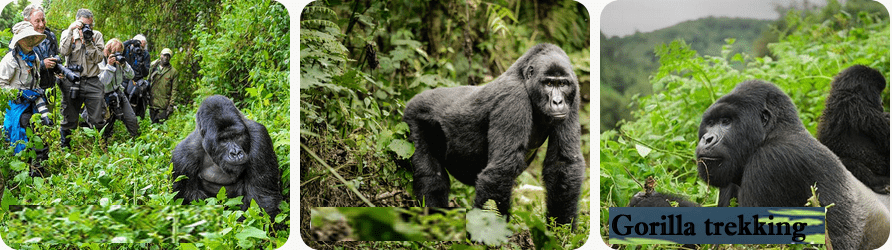
Volcanoes National Park is Rwanda’s crown jewel. The primary draw is mountain gorilla trekking ($1,500 USD per permit), limited to 8 people per gorilla family per day — book months in advance. Even if gorillas aren’t on your agenda, the park offers golden monkey trekking, Dian Fossey’s tomb hike, and summit treks up volcanoes like Bisoke. Road note: Rwanda has some of the best-maintained roads in East Africa. Paved roads reach the park gates.
🇺🇬 LEG 2: Uganda — Bwindi & Queen Elizabeth NP (Days 3–6)
Border crossing: Cyanika or Katuna (Rwanda–Uganda) — relatively smooth but bring all vehicle documents, insurance, and your carnet if applicable.
Bwindi Impenetrable Forest sits just across the border and shelters roughly half of the world’s remaining mountain gorillas. Gorilla permits here run $800 — significantly cheaper than Rwanda — and the trekking experience through the ancient jungle is arguably more raw and atmospheric. Allow a full day; treks can take 2–8 hours depending on where the gorilla families have moved.
Drive: Bwindi → Queen Elizabeth NP (~3–4 hrs on sometimes rough roads
Queen Elizabeth National Park straddles the equator and packs remarkable diversity into a compact area. The Kazinga Channel boat cruise is among the finest in Africa — dense with hippos, crocodiles, and elephants drinking at the bank. Don’t miss the Ishasha sector in the south, famous for tree-climbing lions who drape themselves lazily across fig branches — a behaviour seen almost nowhere else in the world.
Road note: Uganda’s roads are a real mixed bag. The main Kampala–Kasese highway is good, but tracks inside parks and around Bwindi can be deeply rutted. A 4WD with high clearance is essential — not optional.
🇰🇪 LEG 3: Kenya — Lake Nakuru & Maasai Mara (Days 7–11)
Border crossing: Busia or Malaba (Uganda–Kenya) — the busiest crossings, busier but well-established. Some self-drivers in Kenya opt for Suam in the north for a quieter experience.
Lake Nakuru National Park makes a fine stop en route south. The fully fenced park is a stronghold for both black and white rhinos — if you haven’t seen a rhino yet on the trip, you almost certainly will here. The lake itself draws vast flocks of flamingos and pelicans, and the surrounding forest hides leopards, lions, and the rare Rothschild’s giraffe.
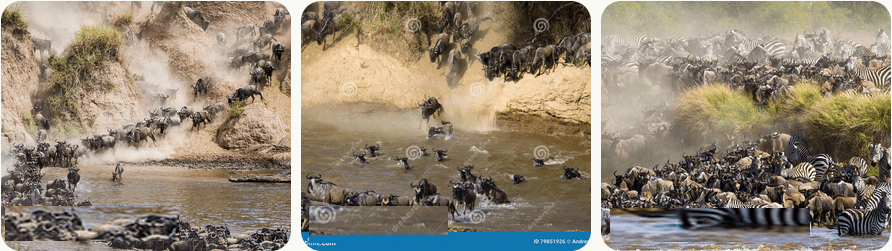
The Maasai Mara National Reserve is the centrepiece of the Kenyan leg. The open grasslands support all of the Big Five year-round, but the reserve transforms between July and October when over 1.5 million wildebeest and zebra pour across the Mara River from Tanzania in the Great Wildebeest Migration — one of the greatest wildlife spectacles on earth. Self-driving is permitted inside the reserve, though the park roads can be demanding after rain and navigation without a guide is genuinely tricky.
🇹🇿 LEG 4: Tanzania — Serengeti & Ngorongoro (Days 12–18)
Border crossing: Isebania/Sirari (Kenya–Tanzania) — the most convenient crossing when coming from the Mara. Tanzania requires a separate vehicle permit (COMESA or TanzRoad sticker) and a tourist visa ($50 USD on arrival for most nationalities).
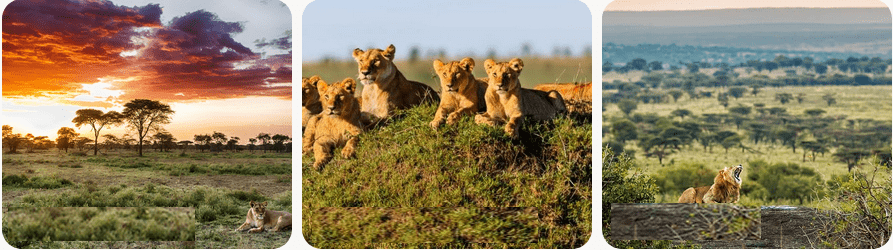
Serengeti National Park is vast — 14,763 km² — and simply one of the greatest wildlife destinations on earth. The Central Seronera Valley offers the most reliable game viewing year-round: lion prides, cheetahs, leopards in acacia trees, enormous herds of buffalo, and some of the densest elephant populations in Tanzania. Plan at least two nights; one is not enough to do it justice.
Ngorongoro Crater is a short drive southeast of the Serengeti. The world’s largest intact volcanic caldera creates a natural enclosure sheltering an extraordinary density of animals — lions, elephants, hippos, flamingos, and critically, some of the last wild black rhinos in East Africa. You descend from the rim into the crater floor for a day excursion; staying on the rim offers some of the most dramatic sunrise views imaginable.
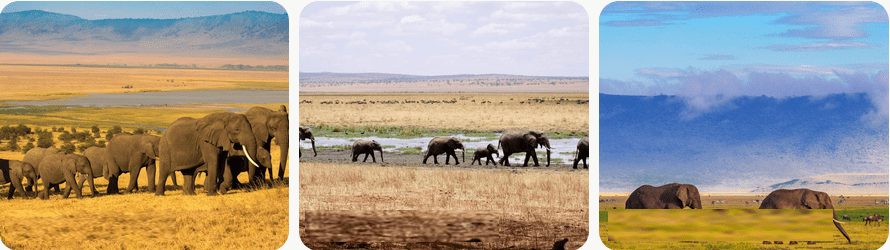
Optional extension — Amboseli National Park, Kenya: If you cross back into Kenya via Namanga, Amboseli rewards with the continent’s most iconic sight: enormous elephant herds against the backdrop of a snow-capped Kilimanjaro. On a clear morning, it’s simply breathtaking.
🚗 Self-Drive Practicalities
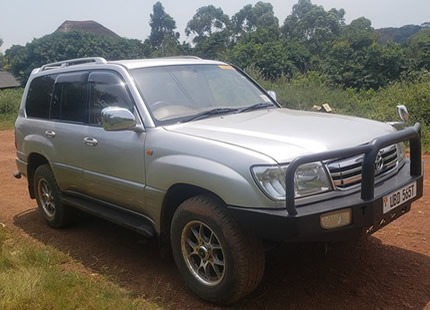
Vehicle: A 4WD with high clearance is non-negotiable. A Toyota Land Cruiser or Land Cruiser Prado is ideal — spare parts are available everywhere. Carry two spare tyres, a high-lift jack, recovery tracks, and a compressor. Roof tents are popular for budget flexibility.
Fuel: Fill up every chance you get. Rural stretches between parks can be long, and fuel quality varies. Carry a 20L jerry can.
Navigation: Download maps.me or OsmAnd with offline East Africa maps before you leave. Google Maps works in cities but falls short in remote park areas. A physical map of each country is worth carrying as backup.
Insurance & Documents: You’ll need your vehicle’s logbook/registration, a carnet de passage or temporary import permit for each country, third-party insurance (get East Africa COMESA yellow card insurance — it covers Uganda, Kenya, Rwanda, and Tanzania), and your international driving licence.
Border fees: Budget for road tolls, park entry fees, and crossing fees at each border. Tanzania’s park fees in particular are significant — around $70–80 USD per person per day for Serengeti, paid in USD cash or card.
🗓️ Best Time to Go
The dry season (June–October) is the sweet spot for the whole route — animals concentrate around water, roads are drier and more passable, and the Great Migration river crossings peak in July–September. The short dry season (January–February) is also excellent and less crowded. The long rains (March–May) make some park tracks impassable and should generally be avoided for self-driving.
💡 Insider Tips
- Book gorilla permits far in advance — both Rwanda and Uganda permits sell out, sometimes 6–12 months ahead for peak season.
- Rwanda is the easiest starting point logistically: well-paved roads, clear signage, safe cities, and you can hire a reliable 4WD in Kigali before heading out.
- Carry USD cash throughout the trip — it’s universally accepted for park fees, border crossings, and remote accommodation. Small bills (under $50) are preferred.
- Don’t rush the Serengeti. Many self-drivers underestimate how large it is and spend too much time driving between gates instead of watching wildlife.
- Stay inside parks when possible. Waking up to birdsong inside Bwindi or the Serengeti is an entirely different experience from commuting in from a nearby town each day.
- Mobile data: Rwanda (MTN/Airtel) and Kenya (Safaricom) have excellent coverage. Uganda and Tanzania are patchier in remote areas — download offline content before you go.
This route is genuinely one of the great overland adventures on earth. The variety — from misty gorilla forest to open migration plains — is unmatched anywhere else in Africa. Take your time with it.