
- admin
- April 20, 2026
- Safaris and Holidays
The Gorilla Highlands: Discover the Ultimate Self-Drive Safari Experience Across Rwanda and Uganda
A Destination Like No Other in East Africa
Few corners of the African continent stir the imagination quite like the borderlands shared between Rwanda and Uganda. Draped in ancient volcanic mist, rippling with emerald hillsides, and alive with some of the rarest wildlife on Earth, this extraordinary region is rapidly earning its place on the global travel map. Whether you are a seasoned adventurer planning a self-drive safari holiday in East Africa or a first-time visitor searching for affordable wildlife tours in Rwanda and Uganda, what you will find here far exceeds any expectation.
We call this region the Gorilla Highlands — and that name is more than a brand. It is a promise. A promise of towering volcanoes, ancient forests, warm communities, endangered primates, and landscapes so breathtaking they feel borrowed from another world. Our goal is simple but bold: to place the Gorilla Highlands on the bucket list of every curious traveller and to ensure that when people visit, they stay longer, spend more meaningfully, and leave richer in experience than they arrived.
Who Is Behind the Gorilla Highlands?
We are an informal but passionate association of professionals drawn from tourism, economic development, conservation, media, and community advocacy. What unites us is a shared belief that responsible travel can transform lives — for visitors and host communities alike. We want you to join our growing network, become a champion for this region, and help us tell its story to the world. Whether you are a travel blogger, a tour operator, a conservation volunteer, or simply a curious soul, there is a place for you in this movement.
Two Countries, One Incredible Self-Drive Safari Journey
One of the most compelling reasons to plan a self-drive safari combining Rwanda and Uganda is the sheer diversity packed into a relatively compact geographic area. These two nations share not only borders and breathtaking scenery but also an interconnected network of national parks, cultural sites, and community tourism initiatives that reward the independent traveller handsomely.
Rwanda’s famous Volcanoes National Park sits in the northwest of the country and shares its ecological boundaries with Uganda’s Mgahinga Gorilla National Park and Bwindi Impenetrable National Park — the latter being a UNESCO World Heritage Site. A multi-day self-drive itinerary through Rwanda and Uganda can take you from the terraced hillsides of Musanze to the mist-shrouded forests of Bwindi, with stunning highland vistas, vibrant local markets, and wildlife encounters punctuating every kilometre of the road.
Infrastructure for self-drive travel has steadily improved in both countries, making this kind of independent exploration increasingly accessible. With careful planning, the right vehicle, and reliable guidance, the best self-drive safari routes in Rwanda and Uganda reward travellers with an intimacy and flexibility that group tours simply cannot match.
The Batwa: Africa’s Ancient Forest People
Among the most profound cultural encounters available in the Gorilla Highlands is meeting the Batwa people, one of the oldest indigenous communities in Africa and the original custodians of the region’s great forests. For millennia, the Batwa — sometimes referred to as “Pygmies,” though many community members prefer to be called Batwa — roamed these forests as skilled hunter-gatherers, harvesting wild fruits and honey, tracking game with trained dogs, and navigating dense woodland with extraordinary knowledge passed down through generations.
Their story, however, carries a painful chapter. As Bantu agricultural communities expanded and cleared forest land, Batwa numbers began to shrink. Then, in the 1980s and 1990s, formal evictions from newly gazetted national parks displaced the Batwa without adequate consultation or compensation, severing their connection to the forests that had defined their identity for thousands of years. In more recent times, government authorities in both Uganda and Rwanda have shown greater sensitivity toward Batwa rights, and incremental progress is being made on land access and cultural recognition.
When seeking authentic cultural experiences in Uganda’s national parks, visitors are strongly encouraged to be thoughtful. Unfortunately, some operators market “see the pygmies” experiences that are exploitative in nature, reducing a rich and complex culture to a performance for tourist consumption. We urge all travellers to avoid such offerings and instead support community-led programmes that share Batwa heritage with dignity and depth.
There are several highly regarded options for responsible Batwa cultural tourism. The Batwa Experience at Buhoma, on the edge of Bwindi Impenetrable Forest, takes visitors on an immersive journey into traditional forest life through costumed re-enactments, music, and storytelling. The Buniga Forest Walk at Nkuringo offers a similar blend of history and drama in another corner of the Bwindi ecosystem. The Batwa Trail in Mgahinga Gorilla National Park guides guests through sacred forest sites and demonstrates ancient skills in their original landscape. For a more contemporary perspective, Batwa Today in Echuya Forest focuses on how the community is adapting to life outside the forest — a programme that complements the historical experiences beautifully and offers insight into the challenges and resilience of the Batwa people today.
The Bantu Farming Communities: Highland Culture in Full Colour
Alongside the Batwa, the highlands are home to several Bantu-speaking farming peoples whose culture adds extraordinary texture to any visit. The people of Rwanda, the Bakiga of Kabale district in southwestern Uganda, and the Bafumbira of Kisoro near the Mgahinga volcano range all share broadly similar ancestral origins, though they are distinguished by different languages — Kinyarwanda, Rufumbira, and Rukiga — as well as their own distinct customs and oral traditions.
Historically, these communities organized their domestic lives around the compound, with each wife maintaining her own household, farmland, and livestock within the extended family structure. Today, the highland landscape reflects both continuity and dramatic change. High population density — among the highest in sub-Saharan Africa in some areas — combined with progressive land fragmentation across generations has pushed many young people to migrate in search of economic opportunities. For the visitor, this creates a fascinating cultural mosaic: ancient practices exist side by side with modern aspirations, all set against terraced hillsides that have been cultivated for hundreds of years.
Mountain Gorillas: The Heart of the Gorilla Highlands
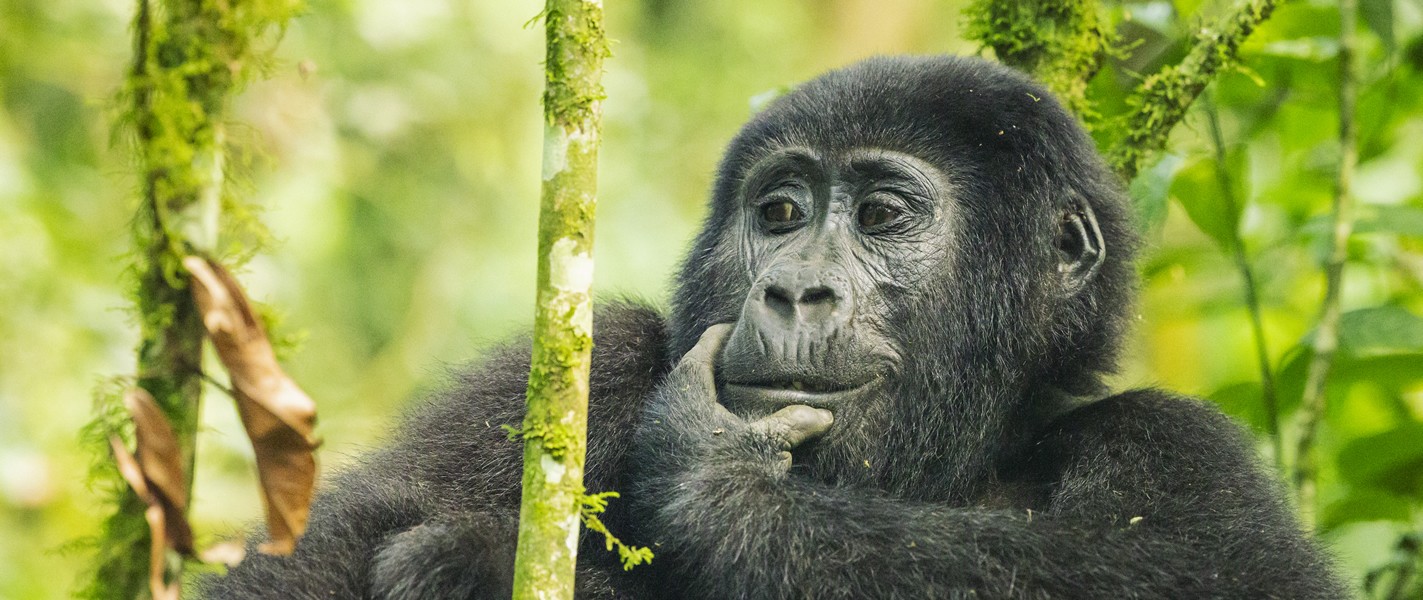
No discussion of this region is complete without dwelling on its most iconic residents: the mountain gorillas. These magnificent animals evolved in concert with the rise of the Virunga volcanoes approximately one million years ago. Over countless generations, they adapted to high-altitude life by developing larger, stockier bodies and considerably thicker fur than their lowland counterparts. Primarily herbivorous, mountain gorillas spend their days foraging for leaves, shoots, roots, and bark, though they occasionally consume ants and termites for supplementary nutrition.
For much of the twentieth century, mountain gorilla populations plummeted due to habitat loss, poaching, and civil conflict. Today, after decades of intensive conservation effort, there are an estimated 1,000+ mountain gorillas remaining in the wild — a number that represents one of conservation’s genuine success stories, though the species remains critically endangered. Gorilla trekking in Bwindi Impenetrable Forest, Volcanoes National Park, and Mgahinga Gorilla National Park gives visitors the rare privilege of observing these animals in their natural habitat, a profoundly moving experience that consistently ranks among the most extraordinary wildlife encounters on Earth.
For those planning a luxury gorilla trekking holiday in Rwanda and Uganda, both countries offer a range of accommodation options from intimate community-run guesthouses to award-winning eco-lodges perched on volcanic ridges.
Golden Monkeys and Other Highland Wildlife
Sharing the bamboo forests of the Virunga volcanic zone with the mountain gorillas are the golden monkeys — a vibrantly coloured primate species equally endemic to this specific ecosystem. Despite their striking appearance, golden monkeys remain far less studied than their gorilla neighbours, making every encounter with them feel like a window into the lesser-known. These social, energetic primates spend most of their time in the mid-altitude bamboo zone, feeding on shoots and socializing in lively troops. Golden monkey trekking in Mgahinga National Park and Volcanoes National Park has grown in popularity as a complementary activity to gorilla tracking.
The broader landscape supports an impressive roll call of other species. Elephants and buffalos move through the forests in substantial numbers, while chimpanzees inhabit woodland corridors within the wider region. Olive baboons, blue monkeys, and the brilliantly coloured red-tailed monkey are frequent sightings on forest trails. More elusive characters include the African civet and various mongoose species, while birdwatchers are rewarded with over 600 recorded species across the parks.
Plan Your Gorilla Highlands Adventure
The Gorilla Highlands region offers something genuinely rare in modern travel: a destination that is simultaneously world-class in its wildlife offering, rich in cultural authenticity, and meaningfully connected to community benefit. Every permit purchased, every community guesthouse booked, every Batwa cultural experience attended channels resources directly back to the people and ecosystems that make this place special.
Whether you are mapping out a budget self-drive safari through Rwanda and Uganda, researching the best time to visit for mountain gorilla trekking, or looking for off-the-beaten-path experiences in the Virunga Mountains, the Gorilla Highlands has the answers — and more importantly, the memories to last a lifetime. Come for the gorillas. Stay for everything else.