- admin
- April 21, 2026
- Wildlife Safaris & Tours
Gorilla Trekking in Nkuringo, Bwindi — and the Ultimate Self-Drive Safari from Kigali
Why Nkuringo Is the Most Dramatic Gorilla Trekking Sector in Bwindi
Gorilla trekking in Nkuringo Bwindi Forest and car hire a 4×4 from Kigali and self-drive across the Rwanda–Uganda border with ease. Of all the sectors within Bwindi Impenetrable National Park, Nkuringo stands apart. Perched on the rim of a dramatic volcanic crater in the southern reaches of Uganda’s most celebrated forest, Nkuringo offers gorilla trekking in Bwindi Impenetrable National Park at its most raw and visually spectacular. On a clear morning, to the Virunga volcanoes rise above a sea of cloud on the Congo border, and the valley below disappears into a tangle of ancient jungle. For travelers doing gorilla trekking in Bwindi from Rwanda, Nkuringo is often the sector of choice — and once you see it, you understand why.
The setting is unlike anything else in Uganda. While other trekking sectors such as Buhoma and Ruhija are more accessible from Kampala, Nkuringo’s position in the south of Bwindi makes it a natural entry point for visitors arriving via Kigali — making it the ideal anchor for any self-drive gorilla trekking safari that begins in Rwanda.
The Trek Itself: What to Expect in Nkuringo
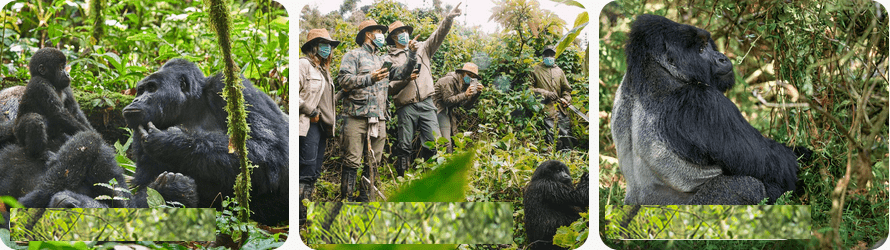
Gorilla trekking in the Nkuringo sector is considered one of the more physically demanding experiences in East Africa — and that is part of its charm. Four gorilla families roam the thick equatorial rainforest across Nkuringo, and locating them on any given day is an exercise in patience, fitness, and genuine adventure.
The day begins around 6:30 AM at the Uganda Wildlife Authority (UWA) briefing point, where rangers introduce trekkers to the gorilla family they will follow. Knowledgeable trackers have already been in the forest since dawn locating the family, so by the time trekking begins, the route is being guided in real time. A recent April 2025 visit recorded a roughly four-hour, nearly 4-kilometre journey through dense vegetation, across steep ridges and down into the crater floor — the kind of immersive, unscripted experience that simply cannot be replicated in a zoo or safari vehicle.
Once the gorilla family is located, trekkers are permitted one hour in their presence. The rules are clear: maintain a minimum distance of 10 metres at all times, though silverbacks and juveniles frequently approach of their own accord. Photography is permitted without flash. Groups are kept to a strict maximum of 8 people per gorilla family per day, with a minimum age requirement of 15 years, ensuring the encounter remains intimate and low-impact. Treks take place at altitudes ranging from 1,200 to 2,600 metres — a wide range that means conditions can shift from warm and humid in the valley to cool and misty on the ridgelines within a single morning.
Porters are available for hire at the briefing point and are strongly recommended. Beyond the practical assistance with bags and muddy terrain, hiring a local porter is one of the most direct ways to support the communities living alongside Bwindi — communities whose buy-in is critical to the long-term conservation of mountain gorillas.
Gorilla Trekking Permits for 2026: What You Need to Know
For the 2025 season, Uganda Wildlife Authority gorilla trekking permit prices remain as follows: USD $800 for foreign non-residents, USD $700 for foreign residents living in Uganda or Rwanda, and UGX 300,000 for East African citizens. Compared to Rwanda’s permit price of USD $1,500 for Volcanoes National Park, Uganda’s pricing makes gorilla trekking in Bwindi from Rwanda an increasingly attractive option for budget-conscious travelers who want the experience without the premium cost.
Permits should be booked well in advance — peak season slots, particularly from June to August and December to February, sell out months ahead. These dry season windows offer firmer trails, clearer mountain views, and generally better photography conditions. That said, gorilla trekking in Bwindi is a year-round activity; the rainforest is always green, and the gorillas are always present.
The Self-Drive Safari from Kigali to Bwindi: An East African Road Classic
One of the most underrated safari experiences in East Africa is the self-drive journey from Kigali to Bwindi, a cross-border road trip that combines Rwanda’s polished infrastructure with Uganda’s rugged wilderness in a single itinerary.
Why start in Kigali? Rwanda’s capital is one of Africa’s most accessible cities, served by numerous international airlines and offering a straightforward visa process for most nationalities. Car hire for gorilla trekking in Uganda and Rwanda is easy to arrange from Kigali, with reputable rental companies offering vehicles equipped for cross-border travel. The drive from Kigali to the Nkuringo or Rushaga sectors of Bwindi takes between four and five hours, making it entirely feasible as a day’s travel — a significant advantage over flying into Entebbe and driving eight-plus hours south.
Rwanda’s Roads: Built for Self-Drive Safari Travel
Rwanda has invested heavily in road infrastructure over the past decade, and it shows. The main routes radiating out of Kigali — north to Volcanoes National Park, west along Lake Kivu, south to Nyungwe Forest, and east to Akagera National Park — are largely tarmacked, well-signposted, and maintained to a standard that consistently surprises first-time visitors.
For travelers planning a self-drive gorilla safari from Kigali to Bwindi, the route via Rubavu and Lake Kivu is both practical and breathtaking. The road winds through terraced hillsides that drop into the deep blue of Lake Kivu, passing small fishing towns, banana groves, and roadside markets that offer a window into everyday Rwandan life. It is the kind of drive that reminds you that getting there is half the journey.
Car Hire for Gorilla Trekking: What You Need
The most important decision when planning a self-drive gorilla safari from Kigali is the vehicle. A 4×4 vehicle is a must for this route — not because Rwanda’s roads demand one, but because the final approach roads into Bwindi’s southern sectors, particularly during the wet season, can be steep, rutted, and unpredictable. A Toyota Land Cruiser or Prado is the preferred choice among experienced safari travelers in the region.
When booking a car hire for gorilla trekking in Uganda from Rwanda, confirm that the rental company provides the “yellow card” — the cross-border vehicle insurance document that is legally required when taking a Rwandan-registered vehicle into Uganda. Reputable companies handle this paperwork as a matter of course, but it is worth verifying before departure. Rental rates typically range from $50 to $200 per day depending on vehicle type and operator, with options available with or without a driver. Self-drive travelers who prefer the independence of navigating the route themselves will find Rwanda’s clear signage and straightforward road layout well-suited to the task.
For those wanting to combine a bush experience with the road trip itself, rooftop tent setups are available through select rental operators — adding a genuine camping dimension to the safari without the need for pre-booked lodge accommodation every night.
The Recommended Self-Drive Loop from Kigali
A well-structured self-drive safari from Kigali combining Rwanda and gorilla trekking in Bwindi typically follows this route:
Day 1–2 — Volcanoes National Park, Rwanda. Drive north from Kigali to Musanze, the gateway to Volcanoes National Park. This is Rwanda’s gorilla trekking destination, as well as the base for golden monkey tracking and hikes up the Virunga volcanoes. Even for travelers with Uganda gorilla permits, an acclimatisation night here frames the landscape beautifully.
Day 3–4 — Lake Kivu Scenic Drive. Head west from Musanze through Rubavu (Gisenyi) and south along the Lake Kivu shoreline to Karongi. This is widely considered one of the finest scenic drives in Central Africa — hill after terraced hill reflected in the deep waters of the lake, with the Congo’s mountains visible on the far shore.
Day 5 — Cross into Uganda via Kisoro or Katuna. Both border crossings are straightforward for travelers with the correct documentation. From Kisoro, the drive into the Nkuringo or Rushaga sectors of Bwindi takes under two hours. The landscape changes immediately — Rwanda’s manicured hillsides give way to Uganda’s denser, wilder vegetation, and the road narrows into something altogether more adventurous.
Day 6 — Gorilla Trekking in Nkuringo, Bwindi. The main event. Rise early, report to the UWA briefing point, and let the rangers lead you into one of the world’s last intact mountain gorilla habitats.
Day 7 — Return to Kigali. The return journey can be completed in a single long day, allowing for a final evening in Kigali before an international departure.
Where to Stay in Nkuringo
Nkuringo Gorilla Lodge occupies a ridge position overlooking the forested valleys of southern Bwindi, with views across to the Virunga volcanoes that reward guests even before the trekking begins. For travelers driving in from Rwanda, it is conveniently positioned just above the sector headquarters and offers a genuine sense of being at the edge of wilderness.
Final Thought: Two Countries, One Great Road Trip
For first-time visitors to East Africa, and for experienced travelers looking for a safari that goes beyond the game drive, the self-drive gorilla trekking route from Kigali to Bwindi is one of the continent’s great journeys. Rwanda brings accessibility and polish; Uganda brings rawness and depth. The gorillas of Nkuringo — unhurried, enormous, and utterly indifferent to the camera — bring something that defies easy description.
Book your Uganda gorilla trekking permit well ahead, arrange your 4×4 car hire from Kigali with cross-border documentation, and give yourself enough days to absorb both countries properly. This is one road trip that earns every kilometre.
Best time to go: June–August and December–February for dry season trekking. Permits: $800 (foreign non-residents), $700 (foreign residents), UGX 300,000 (East African citizens). Car hire from Kigali: from $50–$200 per day.