Best time to visit Rwanda: seasons, gorilla permits and crowds
Rwanda – the Land of a Thousand Hills – is one of Africa’s most amazing travel destinations. Whether you’re coming for Volcanoes National Park’s mountain gorillas, the chimpanzees of Nyungwe Forest or the sprawling savannah of Akagera, knowing when to go can mean the difference between a magical experience and a muddy, expensive disappointment.
Rwanda’s Climate: What to Expect
Rwanda is south of the equator. Altitude varies from about 950 metres in the eastern lowlands to more than 4,500 metres at the peak of Mount Karisimbi. The geography results in a climate not easily categorized as tropical. Rwanda doesn’t have a single wet and a single dry season as many equatorial countries do. There are four seasons in a year – two dry and two wet – which come round every three months or so.
The best time to visit Rwanda is during the Short Dry Season between June and September. Skies are clear, trails through the volcanic forests are firm underfoot, and the cool temperatures at altitude make for truly pleasant trekking – often 10-15°C at night in the Virunga Massif. Visibility is very good for tracking gorillas and for sweeping views across the hills. It is peak season, especially in July and August, when the largest number of international tourists arrive.
The Short-Wet Season (October to November): Afternoon rains, generally shorter and more localised than the long rains. The plants are lush and green, and the woods smell incredible after a rain. The trails are a little slippery, and gorilla trekking is muddier, but the treks are totally doable. The crowds are not so thick as at the dry peak, and prices can sometimes soften a little.
The Long Dry Season (December to February) is another great window for visiting. December is a very popular month because of the holiday season in the northern hemisphere. It’s dry, warm and settled weather. Gorilla trekking is superb, and wildlife viewing in Akagera National Park, which has some ecological similarities to the East African savannah, is at its best as animals gather around waterholes and rivers.
The off-season (March to May) is the Long-Wet Season. Heavy, persistent rains lash much of the country. Forest trails become really tough. The gorillas themselves often move to lower, denser vegetation, which makes them more difficult and physically demanding to track. Fewer people come, country’s demand for permits drops and prices ease off. Those who are budget-conscious and willing to sacrifice convenience for savings can still have a rewarding trip during these months, especially in April and early May, when rains can be punctuated by clear days.
Gorilla Trekking: The Core of the Experience
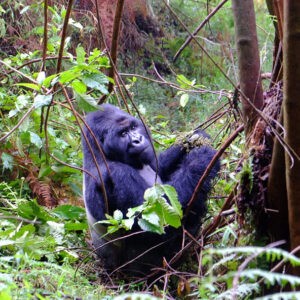
Mountain gorillas are some of the rarest animals on Earth. Rwanda is home to around a third of the world’s remaining mountain gorillas, and the trekking experience in Volcanoes National Park, the same forest where Dian Fossey conducted her ground-breaking research, is considered one of the most profound wildlife encounters possible anywhere.
Visitors are limited to a small number each day – currently eight people per gorilla family per day – and leave in small groups from the Kinigi park headquarters. Rwanda is habituating more and more gorilla families to human presence; by the mid-2020s, there are more than a dozen habituated groups available for tourism and research visits.
The trek itself can last anywhere from one to eight hours, depending on where the gorillas spent the night. The family is tracked by Rangers the night before, and the guides are updated at dawn. You are allowed to spend only one hour with the gorillas, a policy strictly applied for the sake of the animals’ welfare. But for those who do, it is almost universally described as one of the most moving hours of their lives.
All You Need to Know About Gorilla Trekking Permits
Licensing Fees
Gorilla trekking permits in Rwanda are very expensive, by any international standard, and they are meant to be. The Rwandan government positioned itself as a high-value, low-volume destination, with premium prices that pay for conservation, limit environmental impact and also support the surrounding communities that might otherwise compete with wildlife for land and resources.
In 2024, the cost for a regular gorilla trekking permit in Rwanda is $1,500 USD per person for foreign non-residents. East African Community citizens pay a much lower fee, at present around $200. There are also premium permits, the so-called “Gorilla Habituation Experience” which offer four full hours with a gorilla family still being habituated to human presence at a higher cost of around $1,500–$1,800 depending on the season and booking arrangement.
This permit is the largest single expense of many visitors’ trip to Rwanda. It is non-refundable though, if you cancel after a certain window, and should be booked well in advance – particularly for travel in the peak dry-season months.
When and how to book
Permits are sold through the Rwanda Development Board (RDB), which is the agency that sells all national park permits in the country. Bookings can be made directly from the online portal of the RDB or licensed tour operators and travel agencies. The direct RDB route is simple but requires paying it up front and being careful with the cancellation policy.
Permits sell out months in advance for peak season travel — particularly the months of June, July, August and the December holiday window. By January or February of that same year, it’s not unheard of for the prime July and August slots to be booked solid. If you are planning to go on a gorilla trek during this period, treat the permit like a flight booking: get it first then plan everything else around it.
But during the low season (March to May) the availability is usually much better and sometimes you can get a last-minute permit, but it is not guaranteed.
Selecting Your Gorilla Family
The RDB assigns trekkers to gorilla families, as opposed to self-selection. Groups are assigned based on a combination of the date of permit booking and an assessment of the trekkers’ fitness and age. Some families are closer to the park headquarters and tend to bring shorter, easier treks. Others range into higher, more remote territory and include longer, more strenuous hikes. If you are concerned about your physical fitness it is worth mentioning this to the park rangers and your tour operator when you make arrangements. Porters can be arranged for a small extra cost and are highly recommended – they support the local economy and really do help make the physical part of the hike easier.
Crowds and What to Expect By Season
High Season (June-September & December-January)
The driest months see the fullest lodges, the busiest park trailheads, and demand for all ancillary services from airport transfers to restaurant tables in Kigali. The busiest mornings are in July and August when several groups of trekkers depart one after the other from the Kinigi headquarters of Volcanoes National Park. Visitors flock to Nyamirambo in Kigali, the museum at Kigali Genocide Memorial has its longest queues, and budget guesthouses and luxury properties from Bisate Lodge to One&Only Gorilla’s Nest are at or near capacity.
Despite the crowds, the dry season experience is smooth and reliable. Guides are good at pacing groups and the park infrastructure can handle peak volumes without major degradation in quality. The biggest annoyance is just pricing: lodges charge rack rates, permits are in shortest supply and last-minute changes are hardest to work around.
Shoulder Season (October-November and February-March).
These months provide a compelling middle ground. October and November are really good months to visit Rwanda – the rains are manageable; the countryside is green and lovely and permits and accommodation are more available than in peak season. Similarly, many years February is dry or only lightly wet, and visitor numbers are much lower than the holiday-period rush of December.
Travelers visiting in shoulder season often mention feeling like they have more privacy with the gorillas – not because of the eight-person group limit, which is the same all year round, but because of the general feel of Kinigi at dawn, where fewer 4×4 tour vehicles and quieter preperation areas make for a more contemplative start to the day.
Low Season (April-May)
April to May is a very wet period and anyone thinking of this window should do so with realistic expectations. Trails in Volcanoes National Park can be very muddy – gaiters up to your knees are not a fashion statement here but a real necessity. Rain gear, waterproof bags and patience are a must. The rain doesn’t appear to bother the gorillas, but it does make them more erratic, sometimes into thicker, steeper terrain.
That said, Rwanda in the rains is a stark beauty of its own. Arguably the birding is at its best in and immediately after the rains, in Nyungwe Forest National Park, home to chimpanzees and the spectacular Albertine Rift biodiversity. The far eastern Akagera tends to have lighter rain than the western highlands and can offer perfectly good wildlife viewing even in wetter months.
More Than Gorillas: Match the Season to Your Itinerary
Chimpanzee Tracking in Nyungwe Forest
Nyungwe Forest National Park, in the southwest corner of Rwanda, is one of Africa’s oldest rainforests and home to chimpanzees and 13 other primate species. Chimp trekking is possible here year-round, but works best in the dry season, when the forest paths are traversable and the chimps more likely to be in lower, more accessible terrain. The suspended bridge of the canopy walk provides extraordinary views over the forest, and is open year-round, but especially memorable on clear dry season mornings.
Fauna of Akagera National Park
The Akagera, in the east of the country along the Tanzanian border, has a different climatic rhythm from the western highlands. It is hotter, flatter and more visited in the dry season (June to September) when animals congregate around the park’s beautiful system of lakes. Here you’ll see lion, elephant, buffalo, hippo and, since a reintroduction programme in 2017, rhinoceros. The park has been one of conservation’s great recent African success stories.
Kigali and the cultural tourism
Rwanda’s capital is a year-round destination. Clean, safe and increasingly vibrant, Kigali’s restaurants, markets and cultural sites – including the Kigali Genocide Memorial, still one of the most important and sobering sites on the continent – are accessible in any season. Rains may interrupt afternoon plans for a while, but never cause a day in the city to go off the rails.
Practical Suggestions by Type of Traveller
For those whose gorilla trek is the centrepiece and flexibility is limited, July or August still remain the gold standard: dry trails, reliable logistics and a sense of being in Rwanda at its most operationally smooth, at the cost of permits needing to be booked six months or more in advance.
For value-seeking travellers who don’t mind a bit of mud, October or November (especially mid-to-late October) should be seriously considered as the short rains are just starting to set in and the landscape is at its most dramatically green. Availability increases, hotel rates ease, and the experience is not short of its essential magic.
For serious birders or travellers with a keen interest in Nyungwe’s ecosystems, late April to June can be rewarding, as you catch the tail end of the rains and the start of the dry season, combining excellent bird activity with improving trekking conditions.
A Final Thought on When to Get Your Permit
Perhaps the most important planning decision for any trip to Rwanda is not what lodge to book or which airline to use, but rather when, and how quickly, to secure your gorilla trekking permit. Permit is not flexible. Everything else on a Rwanda itinerary is. The $1,500 is a lot to pay, but the experience it buys – sitting quietly in a mountain forest while a family of mountain gorillas goes about its morning, utterly indifferent to you – is one of the rarest and most humbling things a traveller can do anywhere in the world.
Reserve. If you can, visit in the dry season. And bring good boots – waterproof anyway.
To book a permit, visit the official Rwanda Development Board portal at rdb.rw. Permit costs are reviewed periodically by the Rwandan government. Check current pricing before you book.