
- admin
- June 11, 2026
- Gorillas and Primates
Cycling Through Rwanda’s Thousand Hills
Where Every Climb Tells a Story
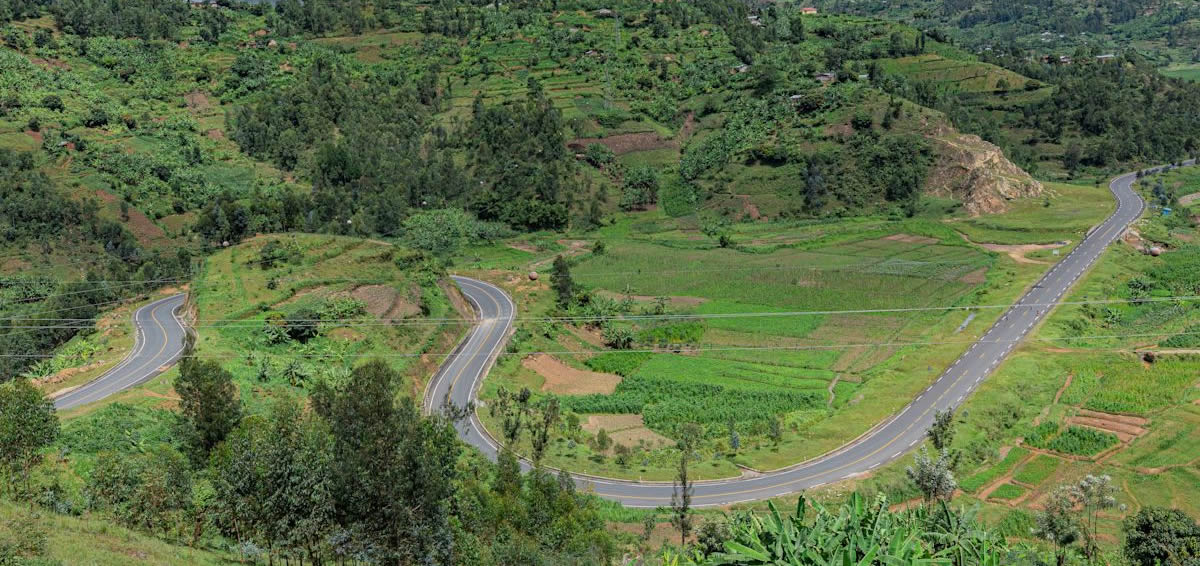
The road rises before you like a wall. Your lungs burn, your legs ache, and the sun bears down on the back of your neck with quiet, relentless force. Then you crest the ridge — and Rwanda unfolds beneath you in a panorama so vast, so improbably green, that the pain dissolves into something closer to wonder. This is cycling in the Land of a Thousand Hills.
Rwanda does not ease you in gently. From the moment you roll out of Kigali’s surprisingly well-ordered streets, the terrain makes its nature known immediately. The hills are not occasional features here — they are the landscape itself, layered and relentless and beautiful. To cycle Rwanda is to understand, in the most visceral way possible, how profoundly a nation can be shaped by its geography.
The Road Out of Kigali
Kigali remains one of Africa’s most navigable and meticulously maintained capitals, and it has grown even more cycle-friendly in recent years. In 2025, the city hosted the UCI Road World Championships — the first time cycling’s premier road event was staged on African soil — a watershed moment that drew the world’s best riders, global media, and tens of thousands of spectators to Rwanda’s streets. The city constructed a dedicated circuit course for the event, and the legacy is visible: freshly surfaced roads, improved signage, and a local cycling culture that has never felt more alive.
The capital sits at roughly 1,500 metres above sea level, and the morning light gives its low skyline a warm amber glow. The roads leading outward pass through red-earth lanes, bougainvillea hedges, and children who sprint alongside shouting “Muzungu! Muzungu!” with cheerful abandon.
Within an hour of leaving Kigali, the true character of Rwandan cycling announces itself. Gradients of eight, ten, even fourteen percent hold for several kilometres at a stretch. What makes them extraordinary, though, is not their punishment but their reward — every summit opens onto views that seem to defy the scale of a country barely larger than Belgium. The valleys below are impossibly lush: banana groves, tea plantations, and smallholder farms clinging to slopes that seem too steep to cultivate.
The Cycling Culture: Enter the Azima
No account of cycling in Rwanda is complete without the azima — the cargo cyclists who have elevated an act of gruelling labour into something approaching mastery. These men, predominantly young, load single-speed bicycles with improbable weights: jerry cans, sacks of potatoes, bundles of firewood, live chickens, and — on one memorable roadside sighting — a full-sized sofa. They navigate the same brutal gradients that send trained athletes reaching for their lowest gears, often barefoot, pushing uphill with a practised, unhurried efficiency.
The azima remain the backbone of Rwanda’s rural supply chain, connecting markets and homesteads across distances that would otherwise require hours on foot. They will overtake you on a climb without apparent effort, and you will feel simultaneously humbled and inspired.
Route of the Gods: Musanze to Lake Kivu
If a single corridor captures everything Rwanda offers the cyclist, it is the route running northwest from Musanze — gateway to the Virunga volcanoes and the mountain gorillas — southward along the Congo-Nile Divide to the shores of Lake Kivu.
From Musanze, the volcanic peaks of the Virunga range form a line of dark, brooding silhouettes on clear mornings. The air at altitude carries the sharp green smell of elevation and coming rain. The Congo-Nile Divide — the watershed separating Atlantic-bound rivers from those destined for the Nile — runs along Rwanda’s spinal ridge, often on unpaved laterite tracks that grip your tyres and cake your frame. Views extend in both directions: the dense, rumpled interior to the east, and the western escarpment dropping sharply toward the Democratic Republic of Congo to the west.
The Tour du Rwanda 2026 featured a full circuit stage at Rubavu, offering spectators close-up racing action along the Lake Kivu shoreline — and amateur cyclists can ride these same roads outside race periods to experience the terrain firsthand. The descent to the lake is long, fast, and exhilarating, winding through eucalyptus forests and ordered tea estates before the water comes into view: wide, blue-grey, rimmed by hills that mirror themselves on its surface.
Akagera and the Eastern Plains
For contrast to the highland drama, Rwanda’s Eastern Province offers a different kind of cycling entirely. The terrain flattens toward Akagera National Park, shifting from volcanic upland to acacia savannah. In the early morning, before the heat builds, cycling the roads bordering Akagera carries a particular thrill: zebra at the roadside, impala threading through thorn scrub, the smell of dry grass and open possibility.
The eastern roads pass through villages of brick houses and swept earthen courtyards, where daily life continues at a pace that a bicycle — unlike a vehicle — actually allows you to absorb.
A Nation That Has Become a Cycling Capital
What has changed most visibly since Rwanda first appeared on the international cycling map is the depth of the country’s investment in the sport. Kigali has been formally designated a UCI Bike City, a designation that positions it for increased funding and the hosting of further major international events. Rwanda’s cycling infrastructure, altitude training facilities, and domestic race calendar have all benefited from sustained national investment.
The guided cycling experience has also matured considerably. Operators in the Gorilla Highlands around Musanze now run community-integrated rides that stop at cooperative farms, weaving workshops, and health projects — journeys that offer a texture of Rwandan daily life impossible to access from a vehicle window. You accept a glass of ikigage sorghum beer from a smiling grandmother. You hold a halting Kinyarwanda exchange with schoolchildren who want to know if you have met Cristiano Ronaldo. These encounters, accumulating over days on the road, are what make Rwanda something beyond a cycling destination.
Practical Notes for the Saddle-Bound Traveller
Most cyclists enter via Kigali International Airport. Bike hire is available in Kigali, Musanze, and along the Lake Kivu corridor. Roads in the west and north are in good condition; laterite tracks in the interior require a mountain or gravel bike. The rainy seasons — March to May and October to November — bring lush scenery but slippery descents; a dry-season visit between June and September offers the clearest skies and firmest ground.
The Tour du Rwanda’s queen stages, typically featuring multiple climbs above 2,000 metres in the Virunga region, can be ridden by any competent cyclist outside of race periods — and riding them gives a visceral sense of what professional riders contend with on this uncompromising terrain.
Altitude should never be underestimated. Much of Rwanda sits between 1,500 and 2,500 metres, and even experienced cyclists from lower elevations will find the first two days harder than expected. Hydrate constantly, start conservatively, and resist the urge to chase the azima on day one.
The View from the Top
There is a moment that arrives somewhere in the middle of a Rwandan cycling journey when the effort stops feeling like a cost and starts feeling like a currency. You pay in sweat and burning legs, and Rwanda pays you back in ridge-top panoramas, in children’s laughter, in the smell of rain on red earth, in the green immensity of a thousand hills stretching to every horizon.
Rwanda has rebuilt itself with extraordinary determination over the past three decades, and that same spirit — resilient, forward-moving, refusing to be flattened — seems to live in the landscape itself. Now, with a UCI Bike City designation, a World Championships legacy, and a race calendar that draws professionals and amateurs alike from every continent, the country has staked its claim not just as a cycling destination, but as one of the world’s great cycling nations.
Every climb still ends at a view. Every valley still holds a village. And every hill, it turns out, is worth the ride.